Understanding the different types of UPS and their characteristics allows you to select the ideal solution for each industrial environment. From standby models for basic equipment to double conversion or modular online systems for plants and data centers, each UPS offers different levels of protection, efficiency, and autonomy that directly impact operational continuity.
Operational continuity in industrial companies cannot be disrupted by power grid failures, sudden blackouts, or unscheduled power outages. Such events can cause irreparable damage to machinery, costly maintenance, and economic losses due to downtime.
This is why Uninterruptible Power Supplies (UPS) are an essential asset that go beyond simple power backup, as they help to avoid various risks associated with power supply instability. In order to select the right solution for each industrial environment, it is necessary to first understand the types of UPS available, their characteristics, differences, and benefits.
What is a UPS and what is it used for?
A UPS (Uninterruptible Power Supply) is known as a key piece of equipment that is mainly used to provide backup power in the event of a power outage in residential or corporate environments. However, in industrial environments, a UPS is also used to improve power quality, filter voltage spikes, compensate for voltage variations, and protect sensitive equipment from harmonics or distortion.
In other words, a UPS serves more than just “giving time to shut down equipment.” These devices are ideal for keeping sensitive equipment that cannot afford even a second of interruption, such as servers, critical control equipment (in hospitals or data centers), or security systems, constantly powered on.
Read also: Industrial UPS: what it is, how it works, and how to choose the best one
Main types of UPS
It is important to remember that not all UPSs work the same way, nor are they designed for the same load conditions or environments (domestic, corporate, or industrial). So, before choosing, we must understand the different types of UPSs and their characteristics.
There are two ways to classify UPSs. First, by topology or operating principle, that is, how they operate internally. And second, by electrical configuration and industrial application, which determines what type of load or environment they are best suited for.
UPS by operating topology
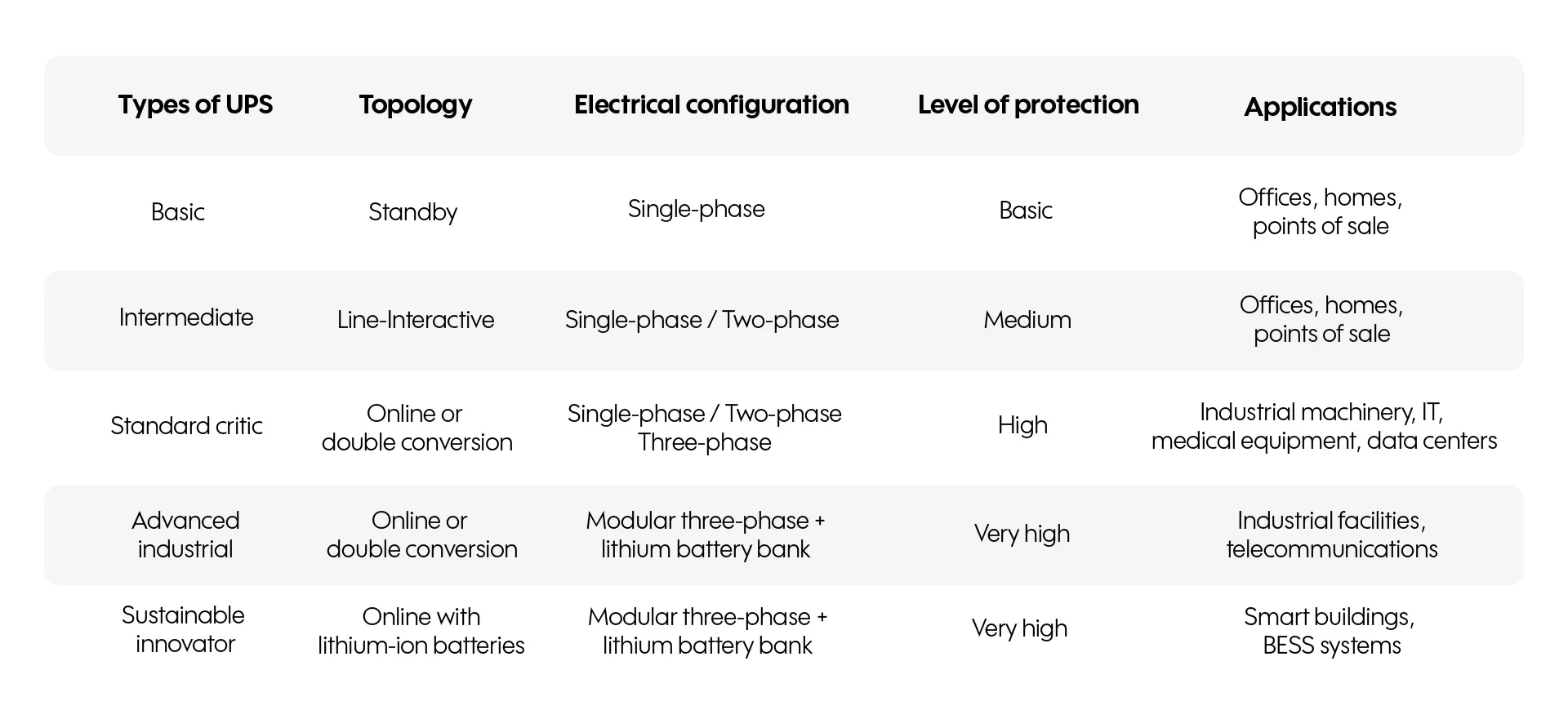
Standby or No Break UPS: this is a basic backup system that draws power directly from the mains and switches to battery power in the event of a power failure. This switch takes between 4ms and 8ms. Ideal for small offices or homes.
Interactive line UPS: incorporates a voltage compensator (AVR) that corrects fluctuations without using batteries. Transfers between 2ms and 8ms. Suitable for less critical loads.
Online or double conversion UPS: powers all the time from the AC→DC→AC inverter, eliminating interruptions (zero transfer time). Offers total isolation and the highest protection. It is the most widely used in industry and data centers.
Read also: Interactive UPS and online UPS: Which is best for your business in Mexico?
UPS by configuration and industrial application
Single-phase and two-phase UPS: suitable for small or medium loads, laboratories, or light automation.
Three-phase UPS: designed for industrial plants, data centers, and critical processes.
Modular and scalable: allow for growth and redundancy without interrupting power supply. Ideal for high availability.
Industrial UPS: reinforced components, 24/7 operation, high robustness, and generator compatibility.
UPS with lithium batteries: higher energy density, lower maintenance, and extended service life.
Comparison between UPS types
Comparison table between topology, configuration, and typical applications:
Key factors for choosing the right type of UPS
- Criticality of the load: identify processes that cannot be stopped.
- Power quality: check for fluctuations, harmonics, and micro-outages.
- Required autonomy: define whether it is short-term backup or a bridge to the generator.
- Efficiency and costs: lithium batteries reduce energy losses.
- Scalability and maintenance: evaluate accessibility and applicable standards (such as NMX-I-163-NYCE-2016).
UPS solutions from Grupo Industronic
Grupo Industronic offers a portfolio designed for the Mexican industrial environment, integrating different topologies and configurations:
- Uninterruptible power systems: from single-phase to modular three-phase models with lithium batteries.
- Specialized consulting: selection, sizing, monitoring, and specialized maintenance.
- Complementary services: energy analysis, integration with SGEn under ISO 50001.
Frequently asked questions about UPS types
What is the best type of UPS for industry?
It depends on the load and the process, but in general, three-phase double conversion online UPS are preferred for industry and data centers. Interactive or standby UPS are recommended for PCs or minor backups.
What maintenance does a UPS require?
Preventive and corrective maintenance is necessary: battery testing, cleaning, fan and connection checks, and transfer tests to ensure stable operation.

Consult our experts for the best option to protect your electrical installation
Our team will provide you with personalized advice