In today’s world, electronic equipment plays a key role in people’s lives, and uninterruptible power supplies have become essential allies in ensuring stable power and immediate backup. They make it possible to reduce the impact of power outages, voltage fluctuations, or unexpected failures that can cause damage, financial losses, and downtime. Below is a comprehensive guide on what they are, how they work, their types, advantages, and the key factors for choosing the right model.
What is a no break and what is it used for?
A uninterruptible power supply is a device that provides emergency or temporary power to critical equipment when there is an interruption in the power supply. In many Latin American countries, such as Mexico, uninterruptible power supplies are associated with devices for use in homes and small offices, with less capacity than UPS (Uninterruptible Power Supply) systems, although in reality, they are systems in the same category. Many models, in addition to providing backup power, help stabilize voltage and filter irregularities, protecting sensitive equipment in offices, businesses, and industries.
Their main purpose is to prevent unexpected shutdowns that can lead to loss of information, damage to electronic equipment, or interruptions in essential processes.
How does a no break work during a power failure?
The no break constantly monitors the power entering the equipment. As long as the supply is stable, the internal batteries remain charged and the current flows normally. When an anomaly is detected, such as a power outage or voltage drop, its inverter is activated to transform the stored energy into alternating current suitable for the connected equipment. The transition occurs in milliseconds, depending on the type of no break, preventing reboots and ensuring operational continuity. The available autonomy is usually sufficient to save information or allow for a safe shutdown.
Comparison of no break types
There are different types of no, each designed for specific needs:
- Offline or standby no break: This is the basic model. It only activates its backup function when it detects a failure. It is economical and suitable as a no break for personal computers or non-critical loads.
- Interactive no break: It has a voltage regulator, which allows it to correct fluctuations without resorting to the battery. It is ideal for offices, small businesses, and areas with frequent variations.
- Online no break or double conversion: This is the device that provides the greatest protection. The power always goes through an AC-DC-AC conversion process (alternating current is transformed into direct current and then back into alternating current with different characteristics), providing completely clean and stable power. It has no transfer time, making it the ideal choice for data centers, hospitals, industrial processes, telecommunications, and critical applications.
Comparison: no break vs. surge suppressors
Although both devices contribute to electrical protection, their functions are different:
- Surge suppressor: protects only against surges caused by electrical discharges, sudden spikes, or network failures. Its function is to absorb or divert that excess energy.
- No break: protects against the above variations and provides temporary backup during power outages. In addition, depending on the model, it regulates voltage and filters electrical noise.
Factors for choosing the right no break
To select the ideal no break, it is advisable to analyze:
- Capacity or power (VA/W): it must cover the total sum of the connected loads, with an additional margin to avoid overloads.
- Desired autonomy: depending on whether you only need to save information or maintain processes for several minutes.
- Type of load: industrial equipment, servers, and medical systems require models with greater precision and protection.
- Technology: offline for basic uses, interactive for offices, and online for critical applications.
- Environmental conditions: industrial facilities require robust, heavy-duty devices.
- Additional features: remote monitoring, management software, alarms, battery expansion capacity, and built-in protections.
With these criteria, it is possible to ensure proper selection and reliable operation.
Benefits of implementing no break in industrial and commercial environments
In the industrial and commercial sectors, having a no break represents a significant competitive advantage, as this equipment prevents:
- Unexpected shutdowns that cause production losses.
- Damage to machinery.
- Interruptions in computer systems.
They also help to:
- Ensure data integrity, the stability of automated processes, and extend the useful life of electronic equipment.
- Reduce wear and tear due to electrical variations.
- Increase the overall efficiency of the system.
- Provide greater peace of mind in the event of any network failure.
In industries such as manufacturing, logistics, telecommunications, and healthcare, clean and constant power is crucial for operational continuity and safety.
Comprehensive solutions from Industronic
Industronic specializes in the design and manufacture of power backup and quality solutions for commercial and industrial applications. The no breaks stand out for their durability, efficiency, double conversion technology, and advanced monitoring capabilities.
The brand offers customized solutions that adapt to the needs of each environment, from corporate offices to production plants, supporting critical operations and improving business continuity. With Industronic’s technical support and specialized advice, companies obtain reliable equipment and comprehensive, high-performance solutions.
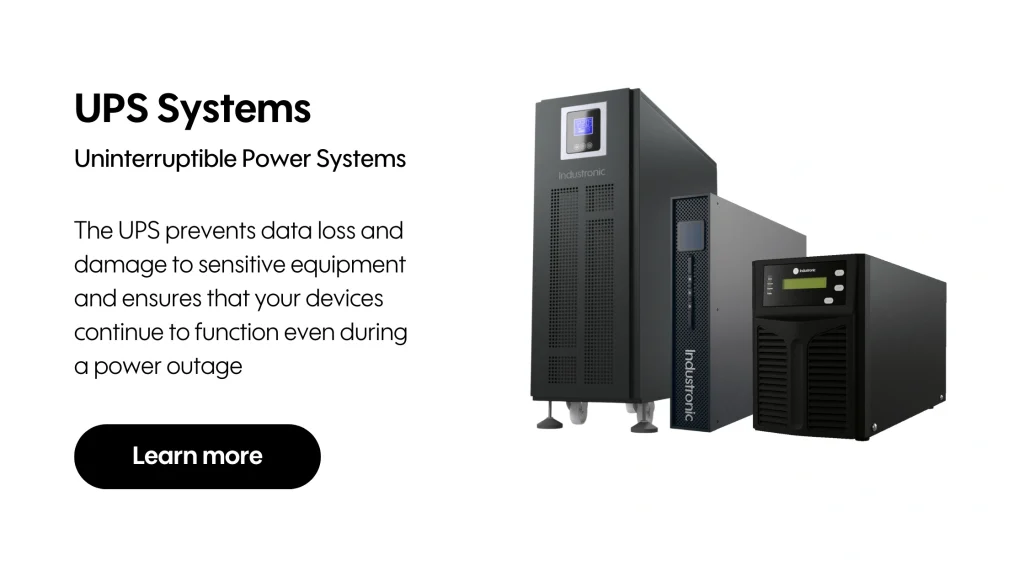
Frequently asked questions about no break
What is the difference between a no break and a UPS?
In reality, there is no functional difference. Both terms refer to the same type of device: an uninterruptible power supply. “UPS” is the international term, while “no break” is the most common name in Mexico and other Spanish-speaking countries, although sometimes more basic devices are called “no break.”
Can I use a no break with a surge suppressor?
Yes. In fact, in environments with high electrical risk, it is recommended to use them together. The suppressor protects against power surges while the no break guarantees backup and stability. They can complement each other to improve the protection of sensitive equipment.
What type of no break do I need?
It depends on the use. For an office computer, an interactive model is sufficient. For servers, production lines, laboratories, or medical equipment, a double conversion online no break is recommended. If you wish, at Industronic we can help you identify your load and suggest the ideal model.
The implementation of a No break not only protects electronic equipment, but also ensures continuity, productivity, and safety in any environment. By understanding its functions, types, and advantages, it is possible to choose the right model for every need. If you are looking for a robust and reliable solution, Industronic offers UPS and comprehensive alternatives that ensure stable power and immediate backup in the event of any electrical contingency.

Consult our experts for the best option to protect your electrical installation
Our team will provide you with personalized advice